Plan a weekend in Lisbon for two around three viewpoints, two gardens and one short ferry ride, and leave the evenings open. The city is built on hills, so the best of it is seen from the top of one, and the best conversations happen on the way up. Wear shoes you can walk in for a whole day.
Why this shape works for two
A weekend away is a long date, and most of what makes a calm first date work applies to it. It goes well when there is something to look at together and room to talk, and it goes badly when every hour is booked. Lisbon is good at the first and forgiving about the second. Its viewpoints, the miradouros, are public squares and terraces, open to anyone, and most of them have a kiosk where you can sit with a coffee for as long as you like.
So this guide plans the days and not the nights. Mornings and afternoons have a place each. Evenings are yours: walk back down, find somewhere small, and decide there.
Friday evening: the first view
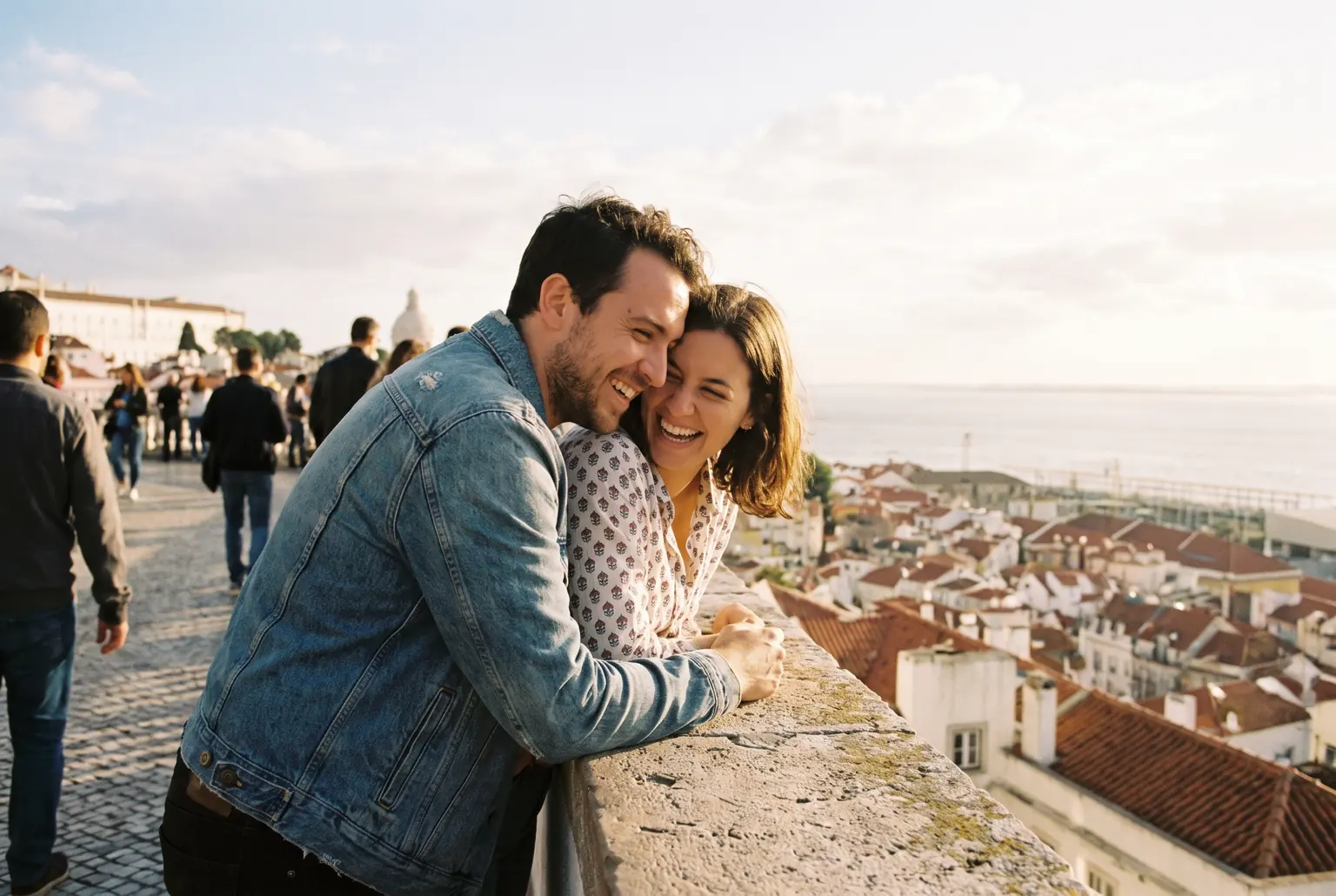
Start high. The Miradouro da Senhora do Monte sits at the top of Graça and looks over the whole city: the Baixa below, the castle to the side, the river beyond. It is the obvious first evening, which is also its problem: at sunset it fills up. If you arrive late on Friday, go anyway and stand at the back. If you’d rather have it to yourselves, keep it for Sunday morning, when it is quiet.
Tram 28 stops at Rua da Graça, and from there it’s a short walk uphill. The tram is small and crowded in the middle of the day; early in the morning or late in the evening it is calmer, and either end of the line is a better place to get on than the middle.
Saturday: a market, a garden and the castle across the valley
On Saturday mornings the Feira da Ladra spreads across Campo de Santa Clara, behind the monastery of São Vicente de Fora. It is a flea market, held on Tuesdays and Saturdays, and Saturday is the bigger day. Nobody needs anything from it, which is the point: you learn more about someone from what they pick up at a flea market than from an hour of questions. Go early, and keep your bag in front of you.
Walk down through Alfama for lunch. Don’t plan where. The streets are narrow and the small places change; pick the one where the people inside look like they live nearby.
In the afternoon, take the metro or a taxi up to the Gulbenkian Garden. It belongs to the Calouste Gulbenkian Foundation, it is open every day from sunrise to sunset, and you don’t need a ticket. The landscape architects António Viana Barreto and Gonçalo Ribeiro Telles finished it in 1969, and they made it a piece of Portuguese landscape instead of a formal layout of paths and flower beds: paths that wander, water, shade, benches where you’d want to sit. It is the quietest two hours of the weekend. Use them.
At the end of the day, cross to Bairro Alto for the Miradouro de São Pedro de Alcântara, a garden terrace on two levels that looks across the valley to the castle. There is a tile map that names what you can see. The Glória funicular that used to climb beside it has been closed since its fatal accident in September 2025, so walk up from Restauradores or along Rua da Misericórdia. The climb is short and steep.
A weekend away is a long date. It goes well when there is room to talk.
Sunday: Belém, the river and a last garden
Go to Belém in the morning. The Jerónimos Monastery and the Tower of Belém have been a UNESCO World Heritage Site together since 1983, and the monastery is closed on Mondays, which makes Sunday the day. Next door, Pastéis de Belém has made its custard tarts to the monastery’s recipe since 1837. There is often a queue.
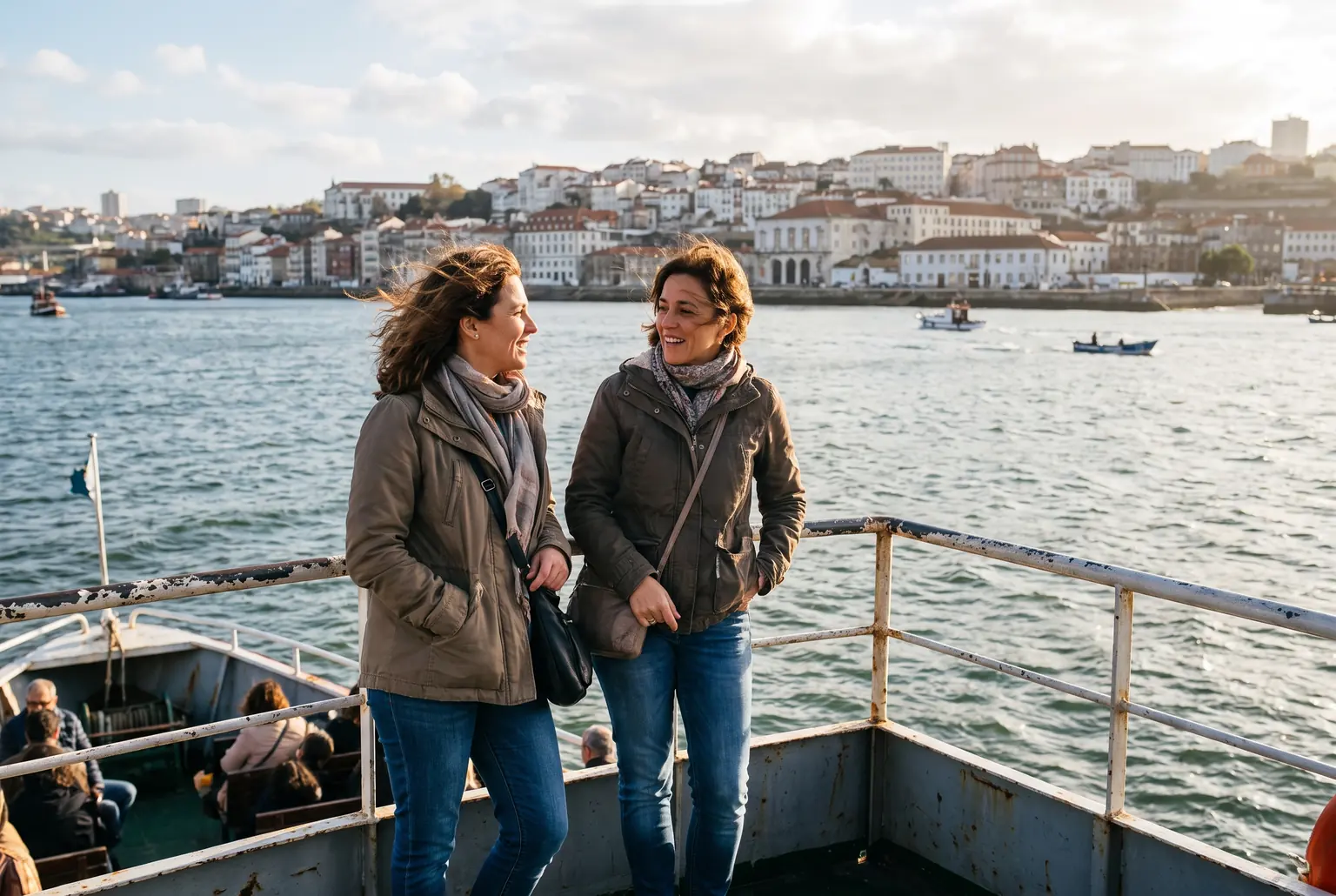
Come back along the river to Cais do Sodré and take the ferry to Cacilhas. The crossing takes about ten minutes, boats leave every quarter of an hour or so, and it is the easiest way to see the whole city from the water. Stand outside. On the south bank, walk along the quay, then cross back as the light goes.
If you still have an afternoon, finish in the Jardim da Estrela, across from the Basílica da Estrela. It opened to the public in 1852, it has an iron bandstand that was moved there in 1936, and on a Sunday it fills with people from the neighbourhood doing nothing in particular. It’s a good place to talk about whether you’d do this again.
Where to stay, by how much you like to climb
Lisbon’s neighbourhoods are as much about height as about character, and at the end of a long day that matters more than either of you will admit on the first morning.
- Baixa and Chiado sit in the low middle of the city, between the hills. Everything in this guide is a walk or a short ride away, and the streets are busy late.
- Alfama is the oldest quarter: steep, narrow, beautiful, and a climb home every night. Choose it if you like that kind of evening.
- Príncipe Real and Estrela are residential and green, with gardens and fewer visitors. They are a little further from the river and a little calmer.
Whichever you pick, agree on it together. Where you sleep decides what the last walk of each evening is like.
If you only have a day
Keep two things. Belém in the morning, for the monastery and the tarts, and the ferry to Cacilhas and back as the light goes. Between them, sit somewhere with a view and do nothing for an hour. One good day beats three rushed ones.
Every place, checked
I luoghi
Miradouro da Senhora do Monte, Graça
A viewpoint at the top of Graça, over the Baixa, the castle and the river. Busy at sunset, quiet in the morning. Tram 28 to Rua da Graça, then walk up.
Verificato il 13 ott 2026 · Visit Lisboa, Lisbon Portugal Tourism
Feira da Ladra, Campo de Santa Clara, Alfama
The flea market behind the monastery of São Vicente de Fora, on Tuesdays and Saturdays. Saturday is the bigger day. Go early.
Verificato il 13 ott 2026 · Visit Lisboa, Get Lisbon
Gulbenkian Garden, Avenida de Berna
The Calouste Gulbenkian Foundation's garden, designed by António Viana Barreto and Gonçalo Ribeiro Telles and finished in 1969. Open every day from sunrise to sunset, and you don't need a ticket.
Verificato il 13 ott 2026 · Gulbenkian, opening hours, Gulbenkian, history of the garden
Miradouro de São Pedro de Alcântara, Bairro Alto
A garden terrace on two levels, looking across the valley to the castle, with a tile map of what you can see. The Glória funicular beside it has been closed since its fatal accident in September 2025, so walk up.
Verificato il 13 ott 2026 · Visit Lisboa, Euronews, on the Glória funicular
Jerónimos Monastery, Belém
With the Tower of Belém, a UNESCO World Heritage Site since 1983. Closed on Mondays.
Verificato il 13 ott 2026 · UNESCO World Heritage Centre, Lisbon Tourism
Pastéis de Belém, Rua de Belém
The bakery that has made its custard tarts, to a recipe from the monastery next door, since 1837.
Verificato il 13 ott 2026 · Pastéis de Belém, Visit Lisboa
The ferry to Cacilhas, Cais do Sodré
About ten minutes across the Tagus to the south bank, with boats every quarter of an hour or so through the day.
Verificato il 13 ott 2026 · Transtejo Soflusa, timetables, Portugal Visitor, Lisbon ferry terminals
Jardim da Estrela, Estrela
A romantic, English-style garden across from the Basílica da Estrela, open to the public since 1852. Its iron bandstand was moved here in 1936.
Verificato il 13 ott 2026 · Lonely Planet, The Portugal News
Prices and opening hours change. We left prices out, and we checked the places above on the date next to each. If you go, check again before you set out.
Before you book
- Shoes first. The pavements are polished stone and the streets are steep. Flat soles that grip.
- Fewer things, longer. Two places a day is plenty. A weekend that leaves you tired leaves you nothing to talk about.
- Talk about the evenings before you go. One of you may want a long dinner and the other an early night. Agree that you’ll decide on the day, and mean it. Saying what you want, plainly and early, is most of dating with intention.
- Keep a little of the trip for yourselves. Not every hour needs to be shared. An hour apart on Saturday makes the dinner after it better.
If the person you’d go with lives in Portugal, or you’d like to meet someone who does, PairWell lets you choose where the people you meet live: anywhere, or your own country and up to five others.